Intellectual property strategy · Cost variance · Breakeven · A/B testing

IP Distribution
Decision Verticals

A decision guide that helps owners of intellectual property pick how to sell their work, explained step by step for five kinds of stakeholders, using unit economics, cost variance analysis, breakeven analysis and A/B testing.

Status note: certain works referenced by this analysis are in the initial stage of pre-publication copyright registration with the U.S. Copyright Office. No title-specific details are disclosed.

Navigate

Contents

Introduction

Ten Ideas You Will See in This Deck, Explained Simply

Intellectual Property (IP)

What it is: Something you created that the law protects, like a book, song, course or design.

Think of it as: Like owning the rights to a song you wrote: others need your permission to copy or sell it.

How it is used: Registering a copyright with the U.S. Copyright Office is what lets you enforce it in court.

Distribution Channel

What it is: A company that sells your work to buyers, such as Amazon KDP or IngramSpark.

Think of it as: The stores and services between you and your buyer, the way an app store sits between developers and users.

How it is used: Every industry picks channels: apps use app stores, bands use streaming.

Gross-to-Net and Unit Economics

What it is: The path from the price a buyer pays to the money you keep, one sale at a time.

Think of it as: A receipt showing every cut taken out of the price before you get paid.

How it is used: Pharma, consumer goods and music all track gross-to-net.

Contribution Margin

What it is: Money left from one sale after the costs of making that sale.

Think of it as: What each sale adds toward paying off your launch costs.

How it is used: Restaurants and retailers price menus and products with it.

Cost Variance Analysis

What it is: Explaining why one result costs more than another by splitting the gap into causes.

Think of it as: Pinpointing exactly which cost made your take-home smaller than another option's.

How it is used: Finance teams use it every month to compare plan vs actual.

Breakeven Analysis

What it is: How many sales it takes to earn back what you spent to start.

Think of it as: The sale that finally pays back everything you spent to launch.

How it is used: Startups, factories and new product launches all use it.

Sensitivity and Scenarios

What it is: Changing one number, or a few at once, to see what moves the result.

Think of it as: Asking 'what if?' before you commit money.

How it is used: Budget planning, investment cases and infrastructure finance.

A/B Testing

What it is: Comparing two versions fairly to see which one really works better.

Think of it as: Testing two video thumbnails and keeping the one more people click.

How it is used: Websites, apps and marketing teams run these daily.

Cash Timing (DSO)

What it is: How many days pass between a sale and the money reaching your bank.

Think of it as: A job that pays you a month after you work the shift.

How it is used: Every business plans cash this way to pay its bills.

Pool-Based Payouts

What it is: Getting paid a share of one shared pot, split by usage.

Think of it as: Splitting a team's prize money by how many points each player scored.

How it is used: Music streaming royalties and ad networks pay this way.

Executive summary

Three Findings Drive the Decision

$6.79 vs $3.33

The Store's Cut Drives the Gap

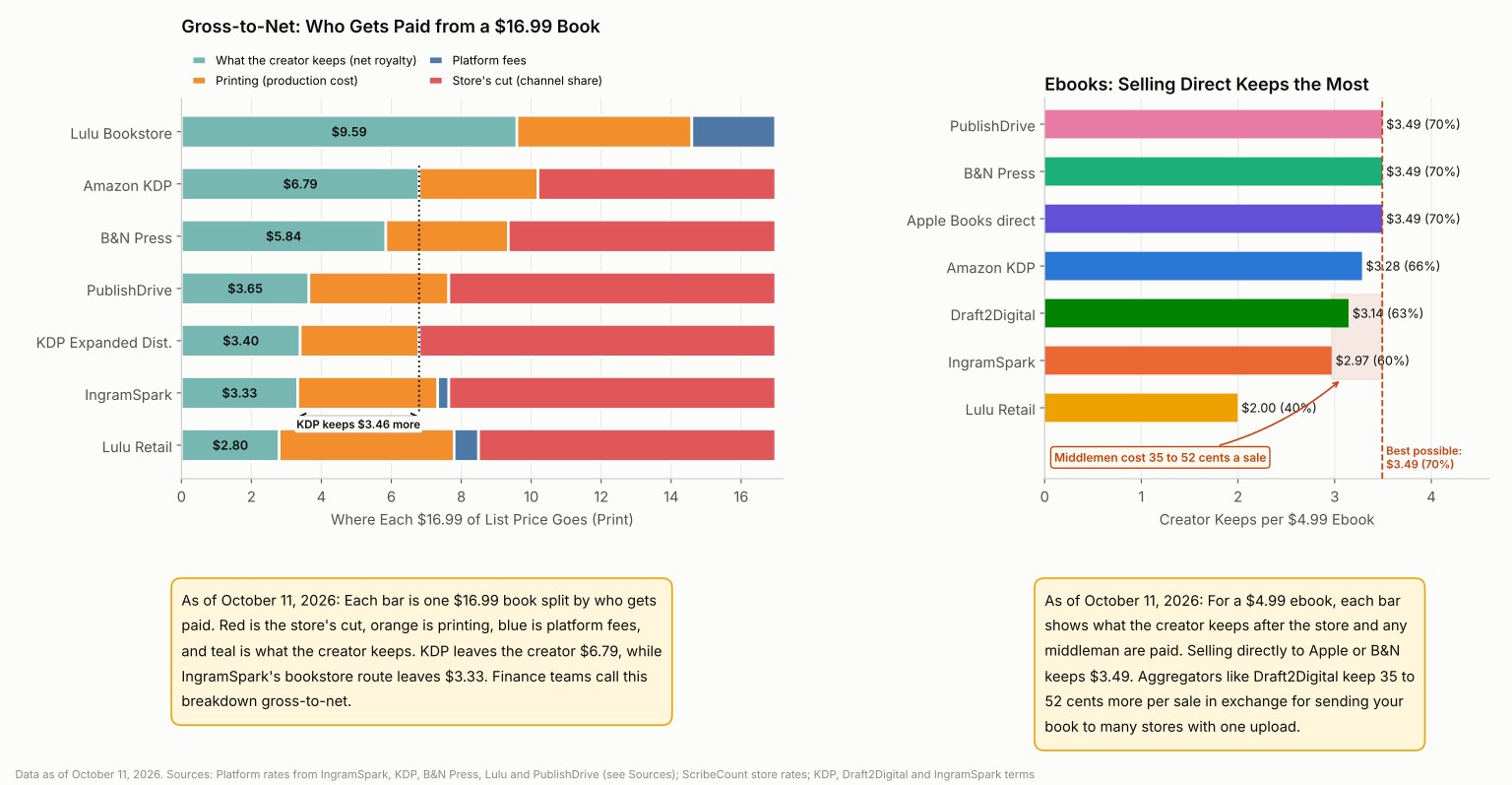
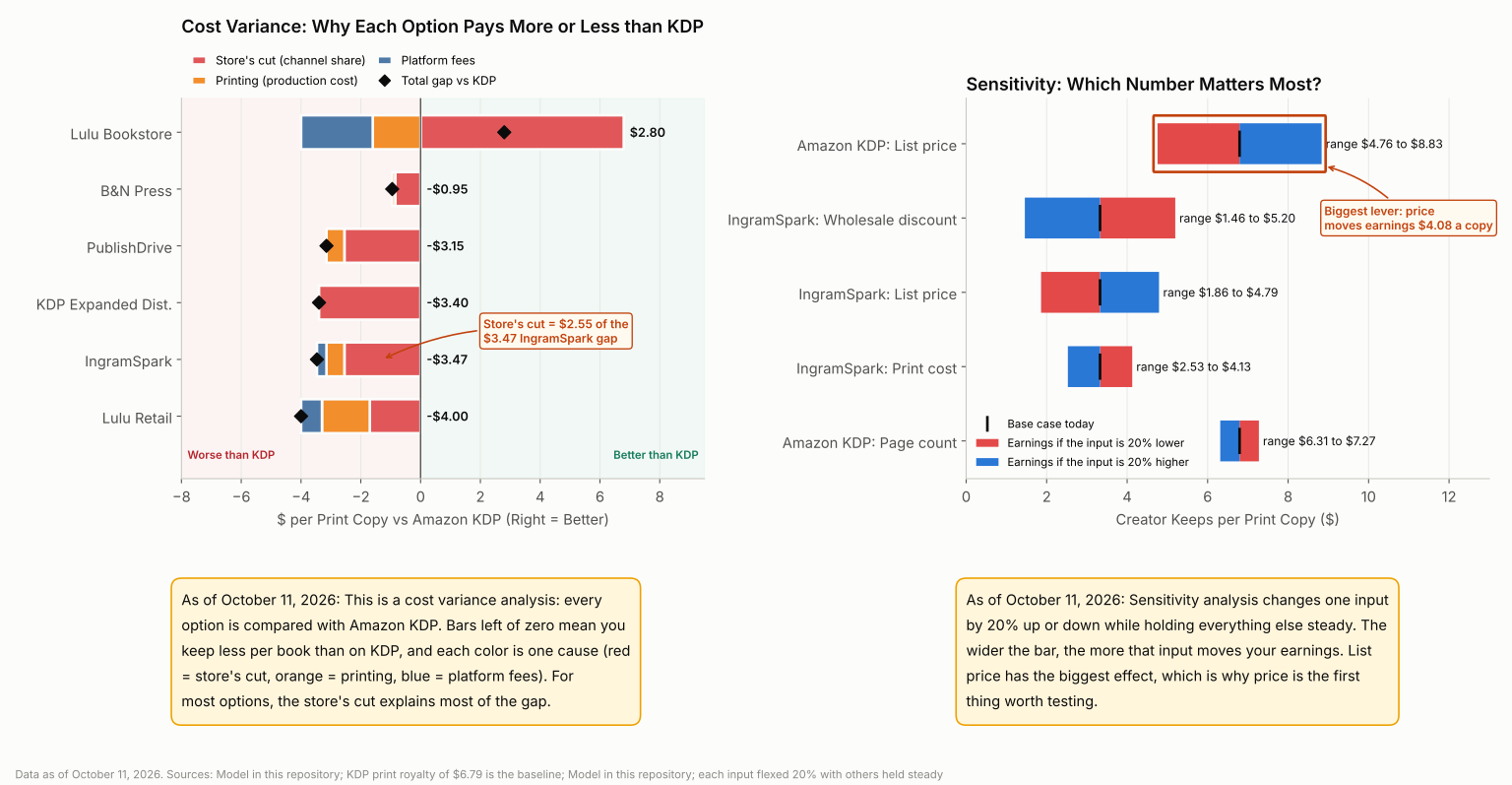
On a $16.99 paperback, Amazon KDP leaves the creator $6.79 and IngramSpark's bookstore route leaves $3.33. About $2.55 of that $3.47 gap is the store's discount. See the variance.

158 vs 272

Payback Depends on Contribution per Sale

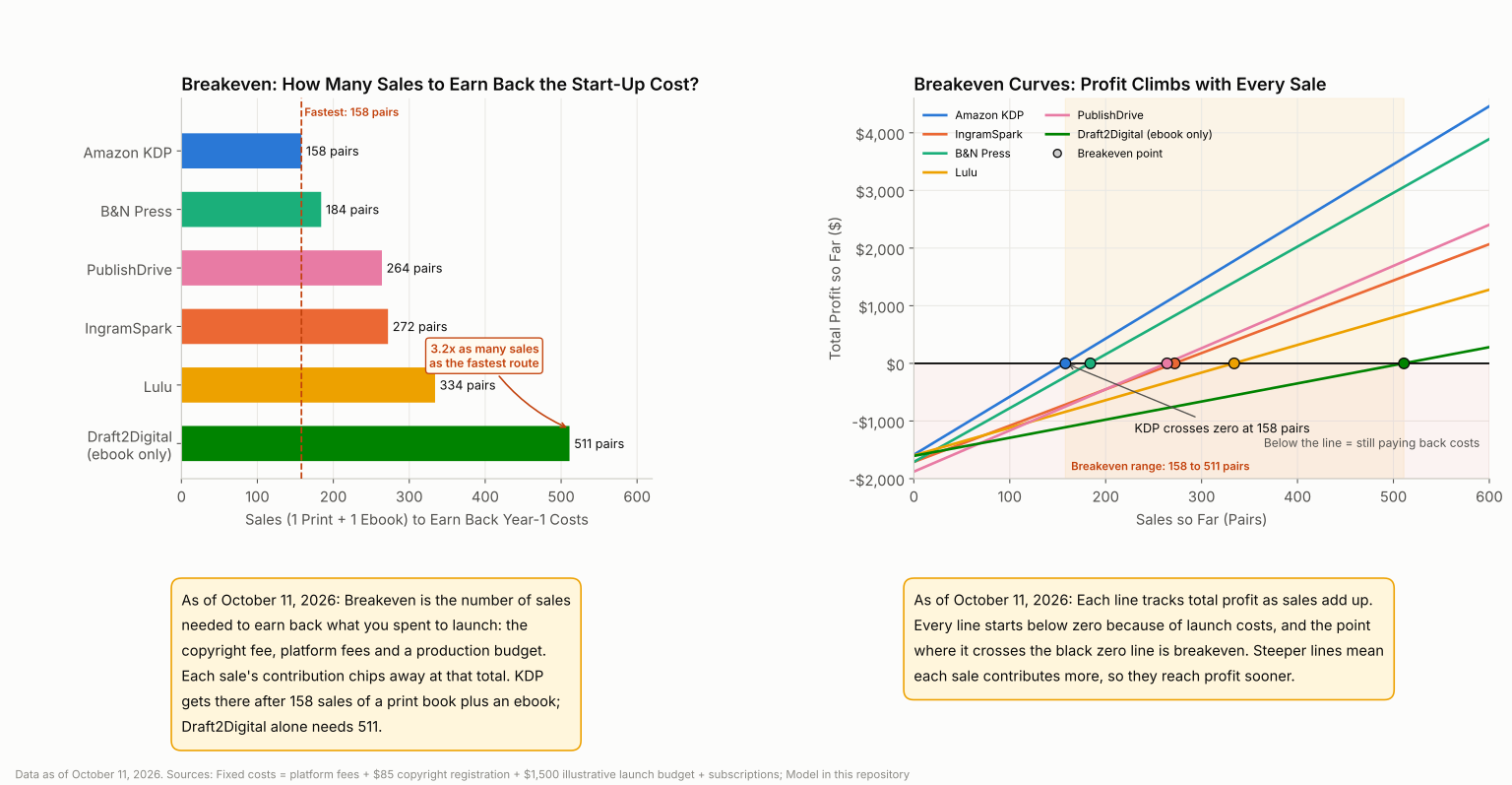
KDP earns back Year-1 costs after 158 sales of one print plus one ebook; IngramSpark needs 272. Platform fees alone are earned back within 42. See breakeven.

16.6 / month

Flat Fees Only Win at Volume

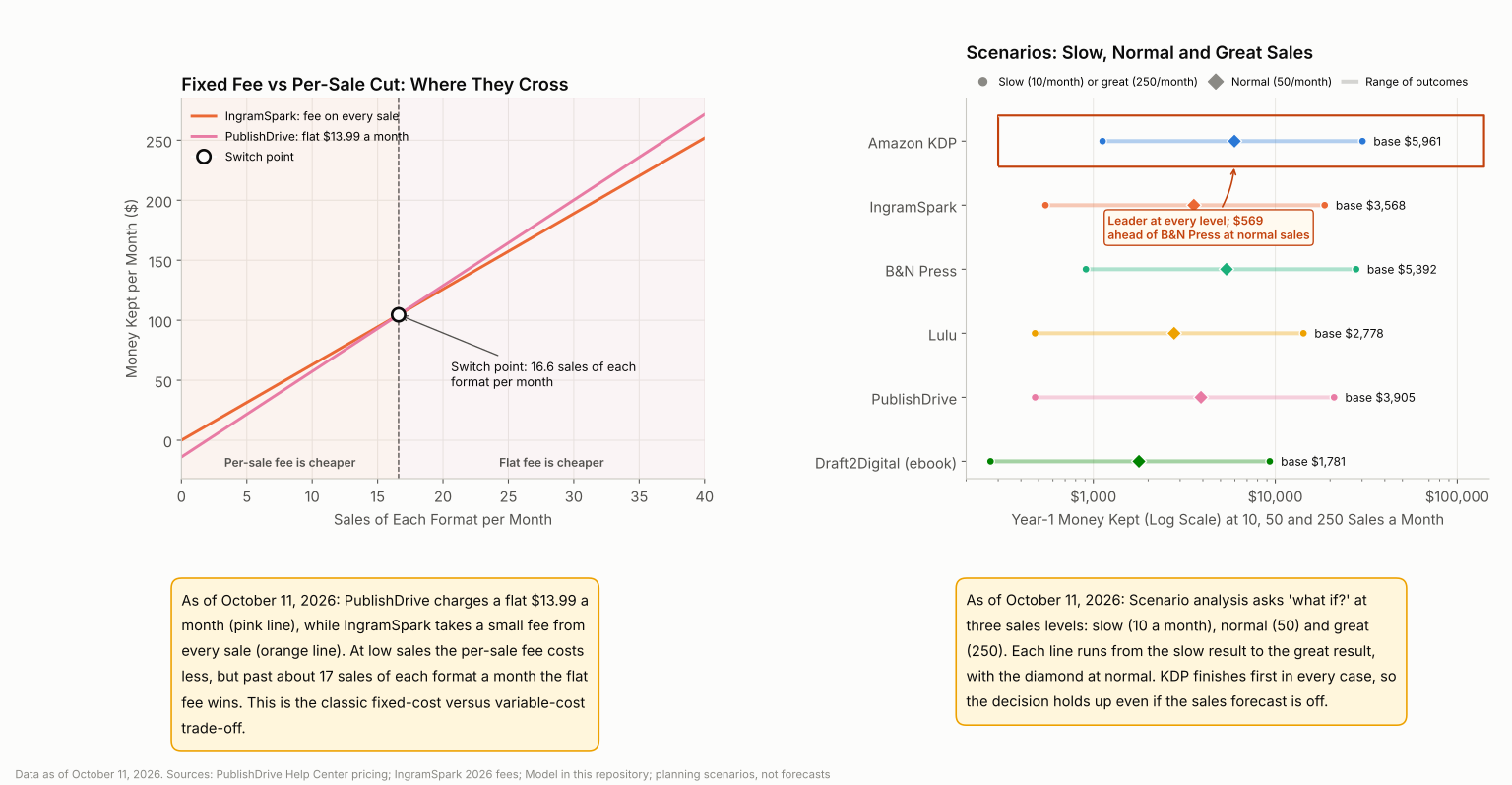
A $13.99 monthly plan beats per-sale fees only above about 17 sales of each format a month. See the crossover.

Decision ask: launch on two channels (KDP plus one route picked from your decision path), keep print non-returnable at launch, and run one 90-day A/B test per quarter. Go to the recommendation.

Stakeholders

Who This Is For: Five Kinds of IP Owners

Every IP owner faces the same question: which sales channels turn a protected work into the most money kept per sale, with risk and cash timing you can live with? The right answer depends on what kind of business you are, so this deck gives each type its own path.

Also inside: guidance for finance and FP&A, marketing, rights and legal, and investors (jump to roles). Click a card to jump to that path.

Market context

Mainstream Benchmarks Frame the Opportunity

Market context

More Books, the Same Number of Buyers
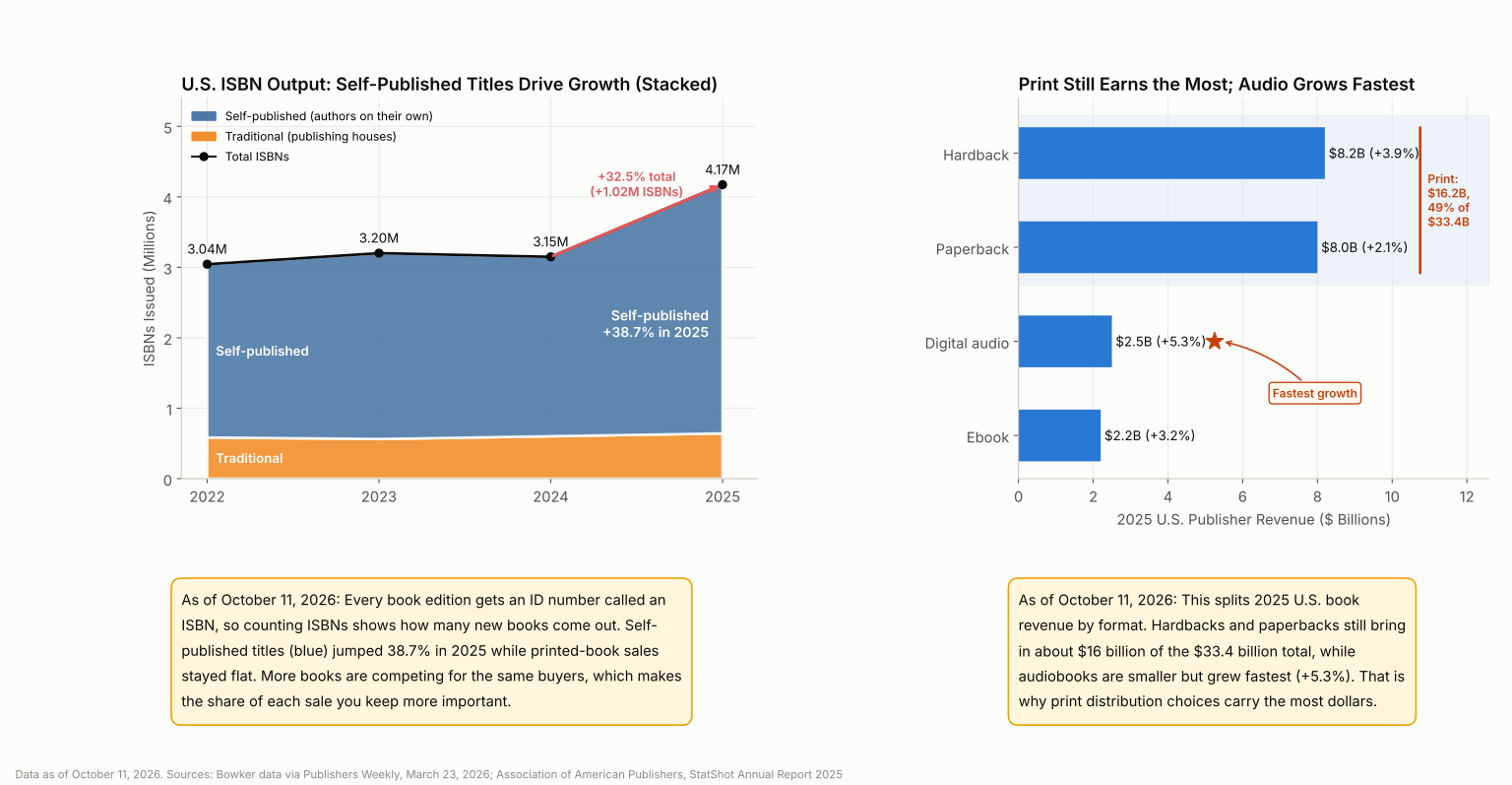
ISBN output and revenue by format
Prices, fees and rates as of October 11, 2026. Sources: Bowker via Publishers Weekly, Mar 2026; AAP StatShot Annual Report 2025

Process flow

The IP Value Chain: From Protected Work to Cash in the Bank

Flowchart of the IP value chain

Step 2 is where rights are secured. Certain works covered here are in the initial stage of pre-publication copyright registration with the U.S. Copyright Office. Registration lets an owner file an infringement suit over a U.S. work and seek statutory damages, so it is counted as a launch cost ($85 under the new fee schedule).

In plain words: you make something, protect it, give it an ID, choose formats and stores, and then money flows back to you after each store takes its share. The dashed arrow means you keep testing and adjusting.
Choice set

Six Options, Three Ways of Charging

PlatformPrintEbookFixed costPayment termsReach
Amazon KDP60% of list minus print70% ($2.99 to $9.99)Free~60 days after month endAmazon only
IngramSparkList minus 35 to 55% discount, print, 1.875% fee85% of store payoutFree setup; own ISBN~90 days after month endBookstores, libraries, 45,000+ outlets
B&N Press55% of list minus print70% flatFree; print ISBN free~30 days after month endBN.com (U.S.)
LuluRetail: 50% fee, print, then 20% commissionFee plus commissionFree; proof requiredMonthlyOwn store, retail, your site
PublishDriveIngram network, 0% commission100% of store payout$13.99 to $83.99/moMonthly400+ stores
Draft2DigitalPrint via partners~90% of store payout$20 account feeMonthly, ~60-day lagApple, Kobo, Google, libraries

In plain words: some stores sell to buyers directly (KDP, B&N), some act as a wholesaler that charges per sale (IngramSpark, Lulu, Draft2Digital), and one charges a flat monthly fee and takes nothing from each sale (PublishDrive).

Unit economics

Gross-to-Net: How Much of Each Sale the Creator Keeps

Cost variance analysis

Why Some Options Pay Less, and Which Number Matters Most

Cost variance drivers and sensitivity tornado
Prices, fees and rates as of October 11, 2026. Sources: IngramSpark Help Center: 2026 pricing changes; Profitable.app KDP royalty calculator
Breakeven analysis

How Many Sales It Takes to Earn Back the Start-Up Cost

Breakeven units and cumulative profit curves

Formula: breakeven sales = Year-1 fixed costs ÷ money kept per sale. The $1,500 launch budget is a placeholder; replace it with your own in the Excel model.
Breakeven analysis

When a Flat Fee Beats a Per-Sale Cut, and What If Sales Are Slow or Great

Working capital

Earning Money Is Not the Same as Having It

Uncertainty and experiments

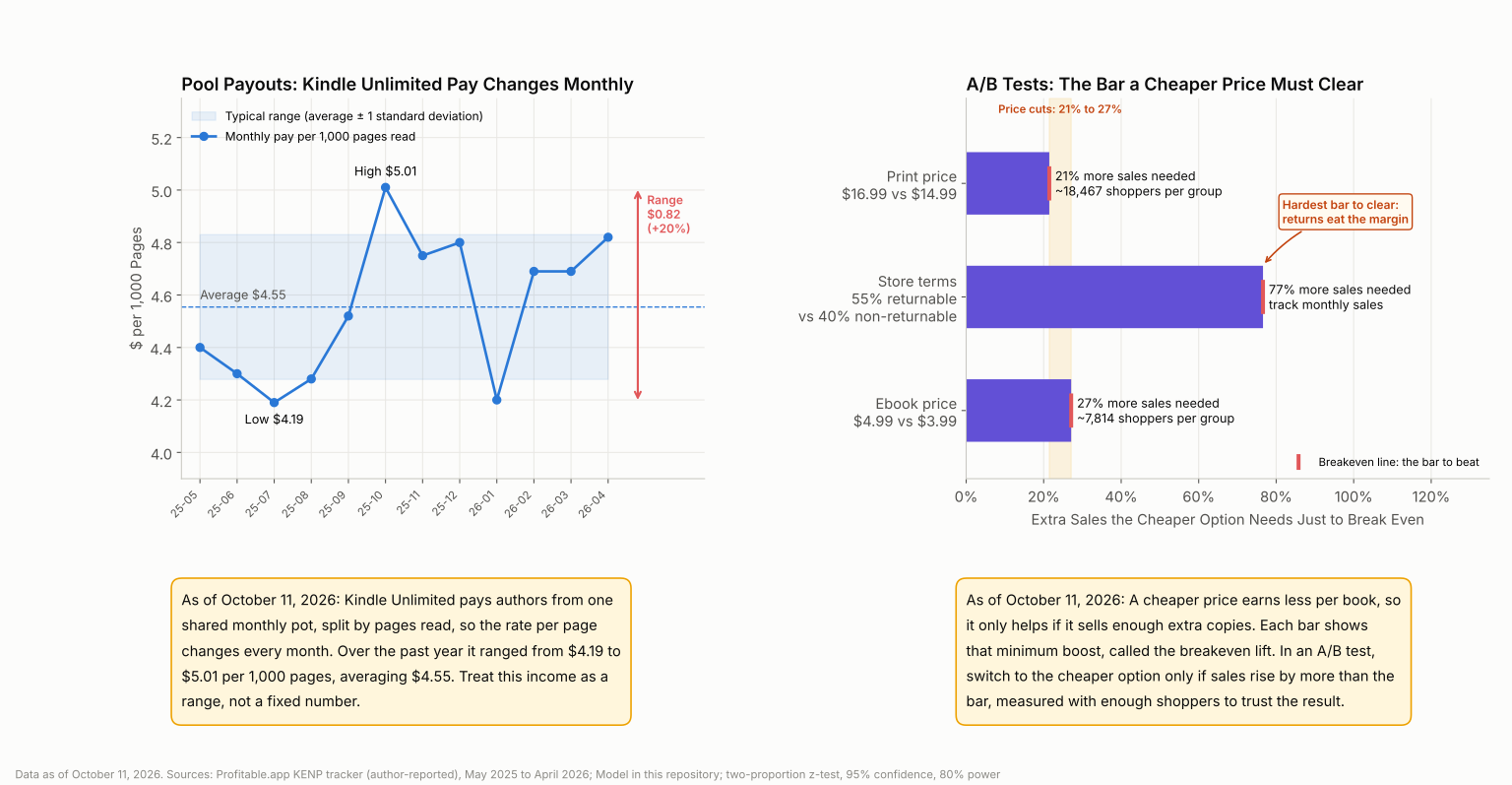
Pay That Moves Every Month, and How to Test a Price Fairly

Risk register

Contract Terms That Change the Economics

RiskWhat the agreement saysRatingMitigationReference
Returns liabilityReturnable titles bill returns back to the IP owner; a 180-day tail applies after switching to non-returnableHighStart non-returnable; test returnability laterSec. 5.4.5
Payment timing and offsetsPaid ~90 days after month end; can be held or offset for returns and other Ingram accountsMediumPlan cash with DSO assumptions; keep a reserveSec. 8.5, 9
Counterparty non-paymentIP owner bears its share if a retailer never paysLow to mediumReconcile statements monthlySec. 8.3
Unilateral changesTerms and pricing can change; compensation changes take effect after 30 daysMediumRe-run the model on each changeSec. 2
Early releaseEnabling distribution lets orders ship before the publication dateMediumEnable distribution only at launchSec. 5.1.2
Liability capPlatform liability capped at $500; broad indemnity owed by the IP ownerLow frequency, high impactConfirm rights and clearances before uploadSec. 12, 13

In plain words: the fine print can take money back later (returns), pay you late, or change the rules. Knowing these ahead of time is part of choosing well.

References are to the IngramSpark Agreement (last updated March 20, 2025). Plain-language business summary, not legal advice.

Prices, fees and rates as of October 11, 2026. Sources: IngramSpark Agreement (Lightning Source)
Decision walkthrough

How to Read the Decision Tree

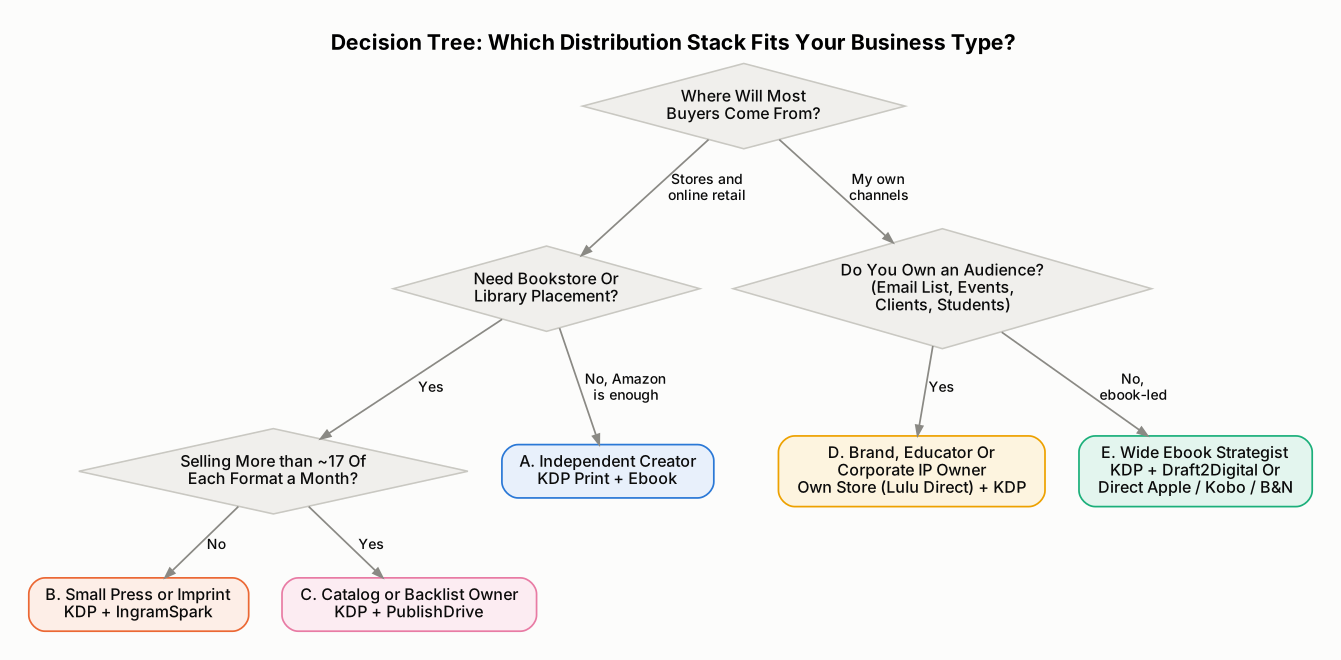
Decision tree by business type
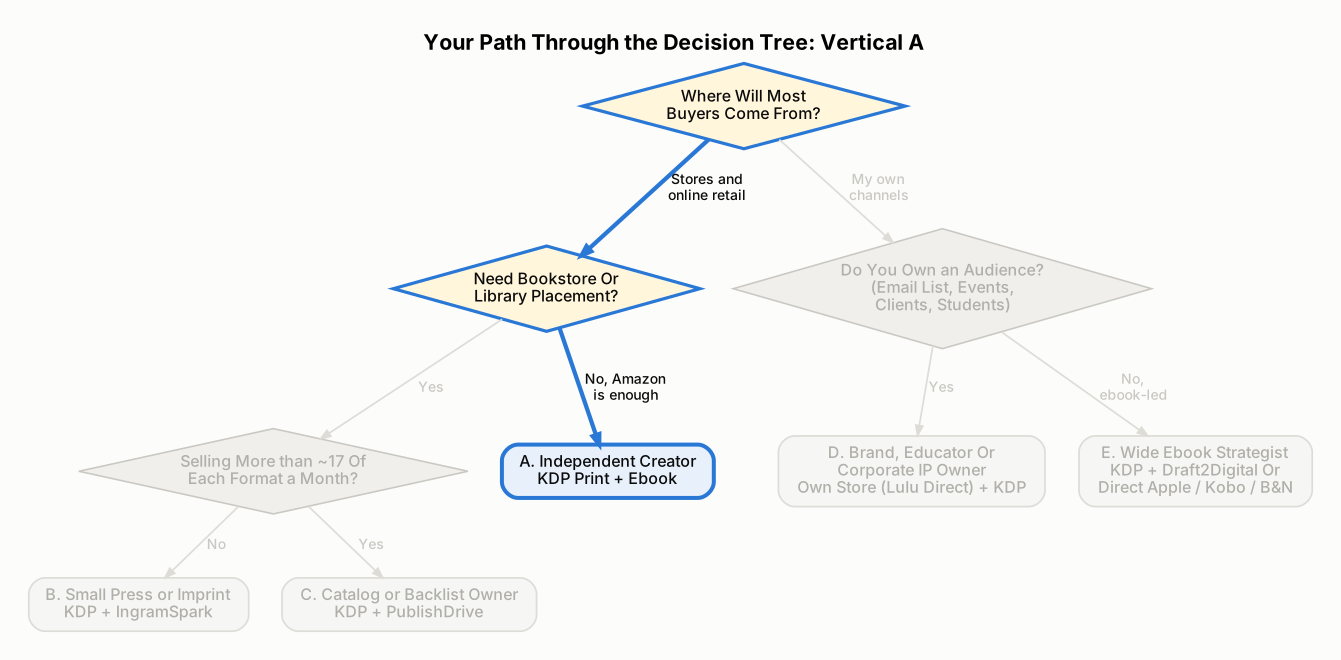
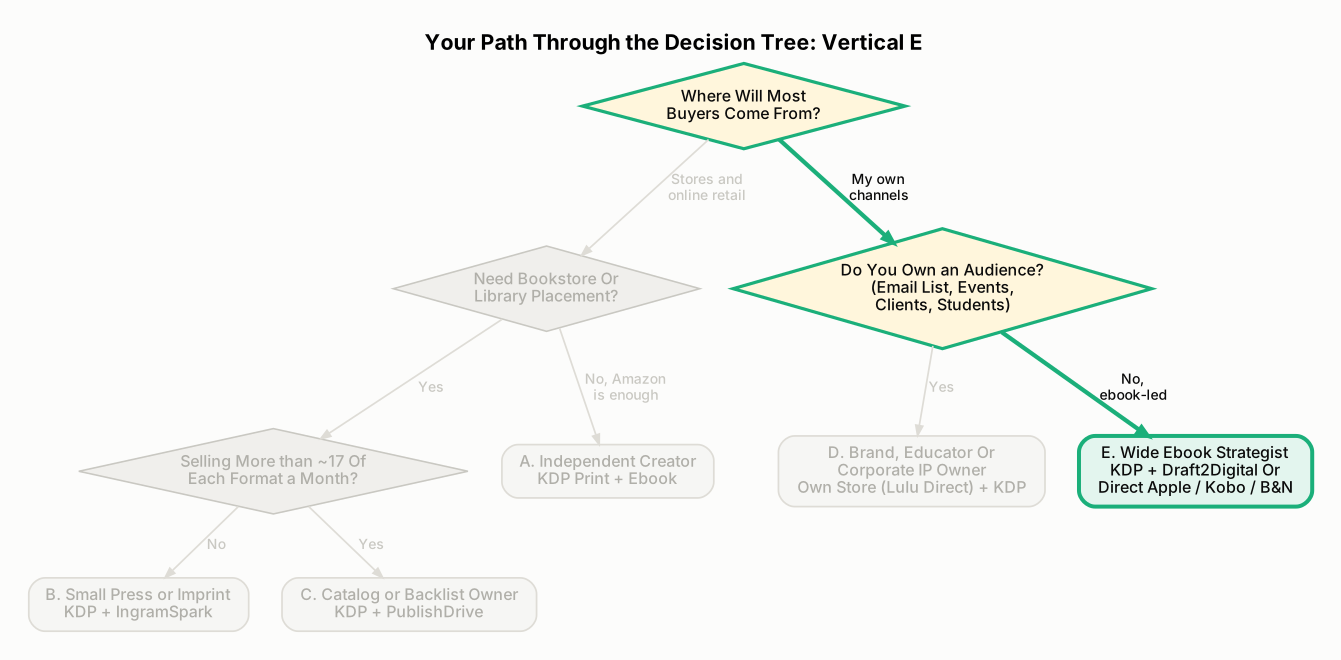
  1. Start at the top diamond. Ask where most of your buyers will come from: stores and online retailers, or channels you own like an email list, events or a website.
  2. Store path: if Amazon alone is enough, you land on Path A. If you need bookstores or libraries, ask how many you sell each month.
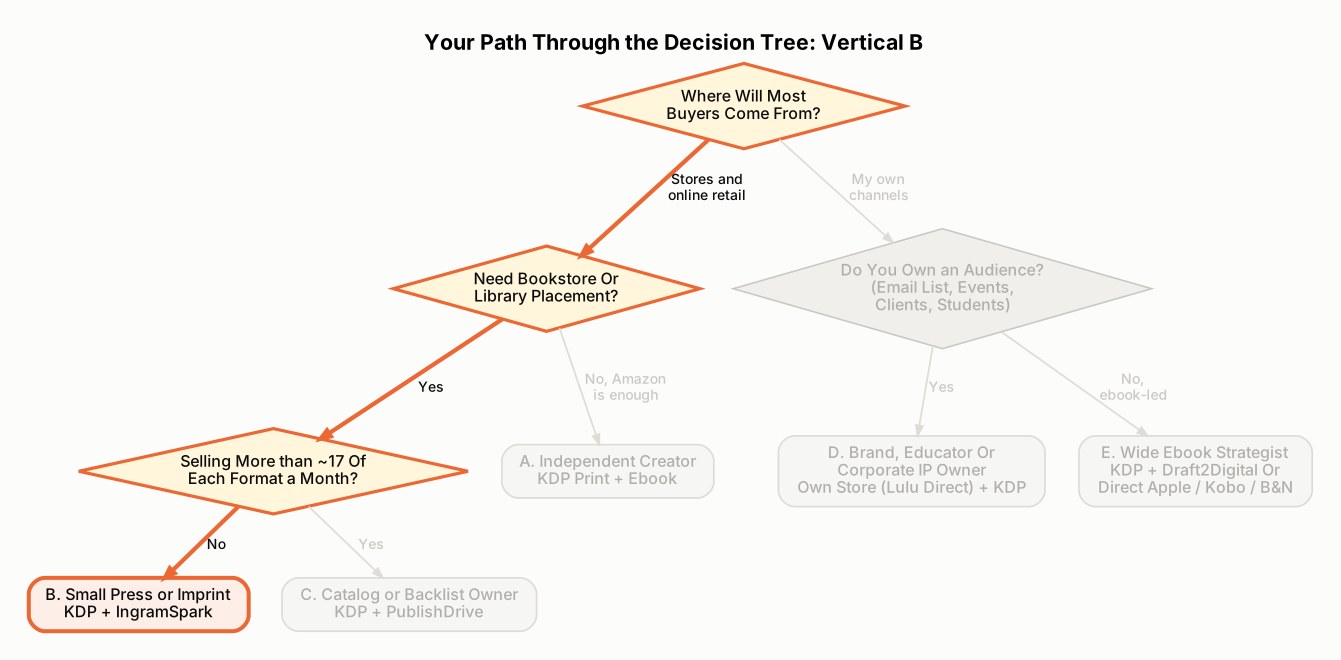
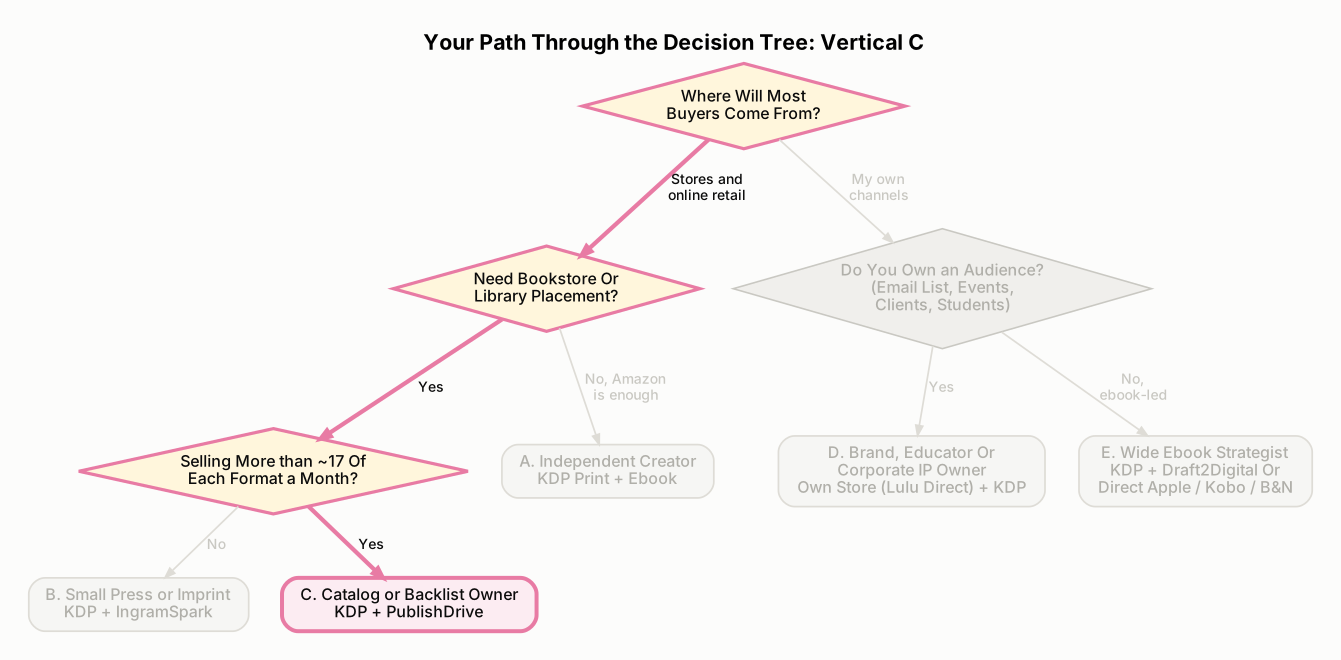
  3. Volume check: under about 17 sales of each format a month, a per-sale wholesaler is cheaper (Path B). Above it, a flat monthly plan wins (Path C).
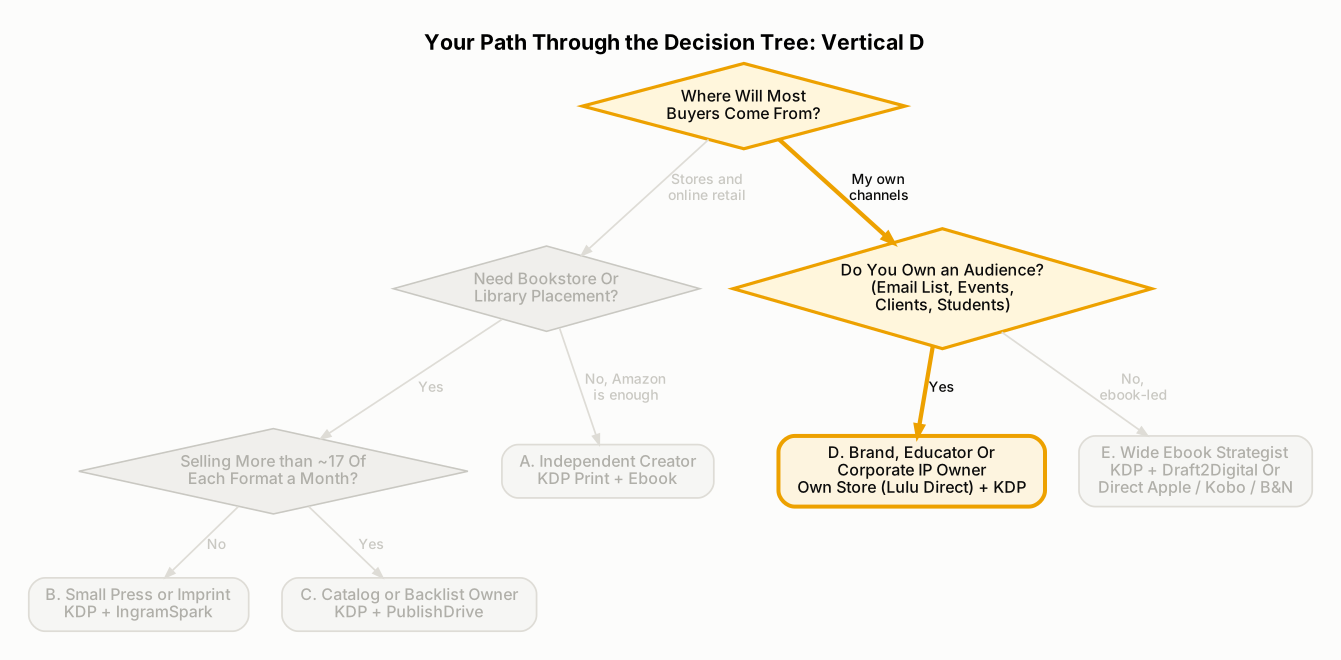
  4. Own-channel path: if you already have an audience, sell direct and keep the store's slice (Path D). If you are ebook-first, spread across every ebook store (Path E).
  5. Then: answer the two follow-on questions on exclusivity and returns.

The 17-a-month switch point comes from the crossover analysis.
Decision walkthrough · Path A

If You Are an Independent Creator: Here Is Your Path

Highlighted decision path for vertical A
Option 1 (recommended)KDP print + ebook
Option 2 (test arm)KDP + Draft2Digital for other ebook stores
Option 3 (stretch)KDP + KDP Select (Kindle Unlimited)

Who you are: One work, discovered mostly on Amazon, with a small budget.

$6.79kept per $16.99 paperback on KDP
158sales (print + ebook) to break even
$5,961Year-1 money kept at 50 sales a month

Summary and Insight

Amazon is where your readers already shop, and KDP keeps the biggest slice of each sale, so it pays back your start-up costs fastest. Adding bookstore distribution now would cut what you keep per book in half without a plan to get shelf space.
What to Do

  • Do now: Publish print and ebook on KDP; price the ebook between $2.99 and $9.99 to earn 70%.
  • Do now: Register the copyright before launch and budget for the $85 fee.
  • Do now: Skip KDP Expanded Distribution; it keeps only $3.40 per copy.
  • Test next: Run a 90-day price test ($16.99 vs $14.99); keep the lower price only if sales rise more than 21%.
  • Watch: Watch breakeven progress monthly; when you pass 158 sales, consider adding a wide ebook route (Path E).
Decision walkthrough · Path B

If You Are a Small Press or Imprint: Here Is Your Path

Highlighted decision path for vertical B
Option 1 (recommended)KDP + IngramSpark, 55% returnable
Option 2 (test arm)KDP + IngramSpark, 40% non-returnable
Option 3 (stretch)KDP + B&N Press + IngramSpark

Who you are: A curated list that needs bookstore and library placement.

$3.33kept per copy at a 55% discount
272sales to break even
105 daysaverage wait for IngramSpark cash

Summary and Insight

Bookstores expect a 55% discount and the right to return books, which shrinks what you keep and adds risk. In exchange you reach 45,000+ outlets that KDP cannot. KDP still handles Amazon, where it pays twice as much per copy.
What to Do

  • Do now: Use KDP for Amazon and IngramSpark for bookstores and libraries.
  • Do now: Start IngramSpark titles non-returnable; switching later leaves a 180-day return tail.
  • Do now: Keep a cash reserve for the 90-day payment lag.
  • Test next: Test 55% returnable against 40% non-returnable; returnable must sell 77% more copies to come out ahead.
  • Watch: Reconcile IngramSpark statements monthly for returns and offsets; revisit Path C if any title passes 17 sales of each format a month.
Decision walkthrough · Path C

If You Are a Catalog or Backlist Owner: Here Is Your Path

Highlighted decision path for vertical C
Option 1 (recommended)KDP + PublishDrive
Option 2 (test arm)KDP + IngramSpark + Draft2Digital
Option 3 (stretch)PublishDrive for everything

Who you are: Many titles with steady monthly sales.

16.6sales/format/month where the flat fee wins
$3,905Year-1 kept on PublishDrive vs $3,568 IngramSpark
$21,038Year-1 kept at 250 sales a month

Summary and Insight

With steady volume, a flat monthly fee costs less than paying a cut on every sale. PublishDrive prints through the same Ingram network, so you keep wide reach while dropping the 1.875% per-sale fee.
What to Do

  • Do now: Keep KDP for Amazon; move wide print and ebook distribution to a PublishDrive plan sized to your title count.
  • Do now: Check each title's monthly sales against the 16.6 switch point.
  • Do now: Use the Excel model to compare plan tiers ($13.99 to $83.99).
  • Test next: Move half the catalog first and compare 90 days of results against titles left on IngramSpark.
  • Watch: Watch per-title volume each quarter; low sellers may be cheaper on a per-sale route.
Decision walkthrough · Path D

If You Are a Brand, Educator or Corporate IP Owner: Here Is Your Path

Highlighted decision path for vertical D
Option 1 (recommended)Own store (Lulu Direct) + KDP
Option 2 (test arm)IngramSpark Share & Sell links + KDP
Option 3 (stretch)Lulu Bookstore + KDP

Who you are: Already has an audience: clients, students, events or a website.

$9.59kept per $16.99 copy sold on Lulu's own store
+$2.80more per copy than KDP
~167own-store sales to break even (estimate)

Summary and Insight

When you bring the buyers yourself, you do not need to give a store its slice. Selling through your own site with print-on-demand fulfillment keeps the most per copy, while KDP lets new people discover you.
What to Do

  • Do now: Sell print copies from your own site with Lulu Direct (no revenue share; you pay printing and shipping).
  • Do now: Keep KDP listed for discovery and reviews.
  • Do now: Use IngramSpark Share & Sell links for one-off campaigns.
  • Test next: Send half your audience to your own store and half to Amazon for one campaign; compare money kept per visitor.
  • Watch: Watch fulfillment costs and customer support load as direct sales grow.
Decision walkthrough · Path E

If You Are a Wide Ebook Strategist: Here Is Your Path

Highlighted decision path for vertical E
Option 1 (recommended)KDP + direct Apple, Kobo, B&N
Option 2 (test arm)KDP + Draft2Digital
Option 3 (stretch)KDP + PublishDrive (above 40/month)

Who you are: Digital-first and wants readers on every ebook store.

$3.49kept per $4.99 ebook sold direct
$3.14kept through Draft2Digital
6.1%monthly swing in Kindle Unlimited pay

Summary and Insight

Going direct to Apple, Kobo and B&N keeps the most, but takes more uploads. Draft2Digital trades about 35 cents a sale for one upload. Kindle Unlimited pays from a shared pot that changes monthly, so it is less predictable.
What to Do

  • Do now: Publish the Kindle edition on KDP directly.
  • Do now: Use Draft2Digital for other stores, or go direct to Apple, Kobo and B&N if you can manage several uploads.
  • Do now: Price between $2.99 and $9.99 to keep KDP's 70% rate.
  • Test next: Test exclusivity: enroll one title in KDP Select for one 90-day term and compare to a wide title.
  • Watch: Plan Kindle Unlimited income as a range; above 40 ebook sales a month, compare a PublishDrive plan.
Decision walkthrough

Two Follow-On Decisions for Every Path: Exclusivity and Returns

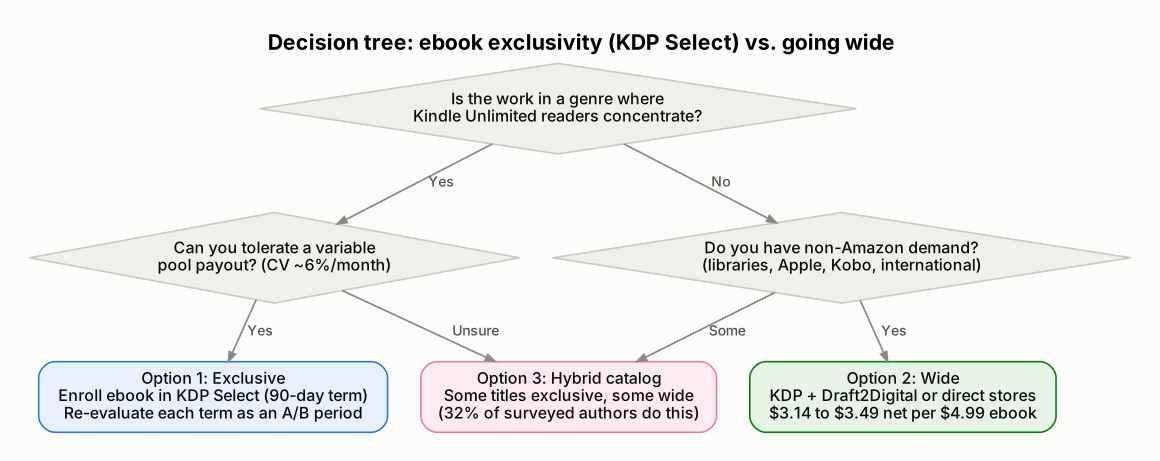
Exclusivity decision tree
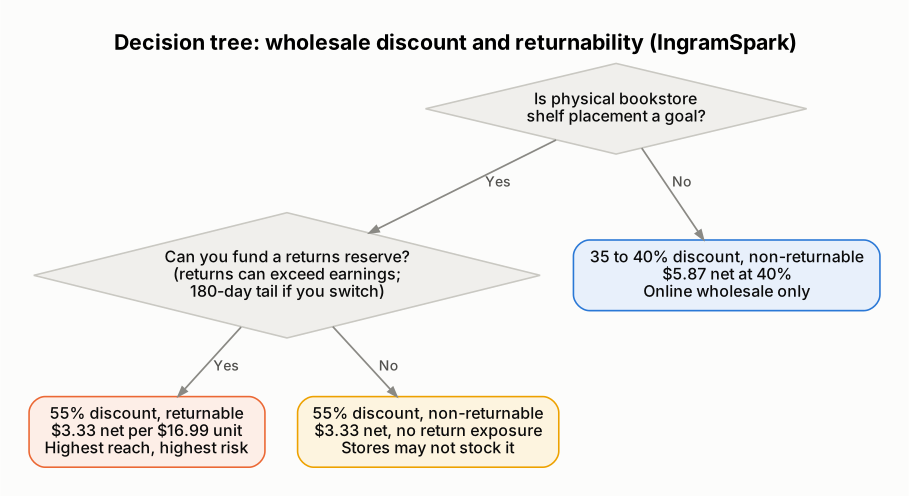
Returns decision tree

Exclusivity, in plain words: Kindle Unlimited is like a library pass that pays authors from a shared pot. You must sell the ebook only on Amazon for 90 days. Choose it if your genre lives there and you can handle pay that changes monthly; otherwise stay wide. 38% of surveyed authors keep every book exclusive and 30% stay fully wide.

Returns, in plain words: letting stores return unsold books gets you on more shelves, but you pay for the books that come back, and that bill can be bigger than what you earned. Start non-returnable unless shelf space is the main goal and you have cash set aside.

Stakeholder roles

What Each Team Should Do, Whatever the Path

TeamTheir job hereWhat they should do
Finance and FP&AOwn the model and the monthly variance review.Track money kept per sale vs plan by driver; forecast cash with 45 to 105 day lags; re-run breakeven when any fee changes.
MarketingOwn price tests and where traffic goes.Run one A/B test per quarter with a pre-set breakeven lift; send owned audiences to the highest-margin store.
Rights and legalOwn copyright registration and contract terms.Register before launch; review returns, liability and change-notice clauses; confirm all rights and clearances before upload.
Investors and partnersJudge whether the plan pays back.Ask for breakeven units, margin of safety, DSO and the scenario range rather than a single sales forecast.
OperationsOwn uploads, metadata and timing.Turn on distribution only at launch; keep ISBNs and metadata consistent across stores; log every price change.
Choice options

Options at a Glance for Every Stakeholder Type

StakeholderOption 1: RecommendedOption 2: Test armOption 3: StretchBreakeven marker
AIndependent creatorKDP print + ebookKDP + Draft2DigitalKDP + KDP Select158 sales
BSmall press or imprintKDP + IngramSpark 55% returnableKDP + IngramSpark 40% non-returnableKDP + B&N Press + IngramSpark272 sales
CCatalog or backlist ownerKDP + PublishDriveKDP + IngramSpark + Draft2DigitalPublishDrive onlySwitch point 16.6/month
DBrand, educator or corporateOwn store (Lulu Direct) + KDPIngramSpark Share & Sell + KDPLulu Bookstore + KDP~167 own-store sales
EWide ebook strategistKDP + direct Apple, Kobo, B&NKDP + Draft2DigitalKDP + PublishDrive (above 40/month)Ebook-only economics

Option 1 keeps the most money per sale for that business type. Option 2 changes one thing and doubles as the B group in an A/B test. Option 3 adds reach once sales can support it.

Recommendation

Decision Request: Two Channels Now, One Test Every 90 Days

1. Launch

Every path lists on KDP plus the one route your decision path picks. Keep print non-returnable at launch and turn on distribution only on release day.

2. Test

One A/B test per 90 days: price first, then store terms. Write down the metric (money kept per visitor) and the breakeven lift before starting, and do not stop early.

3. Review

Hold a monthly variance review and a quarterly re-forecast. Revisit exclusivity and subscriptions once sales pass 17 of each format a month.

A/B test workflow

Success measures: breakeven reached within the planned number of sales; money kept per sale within 5% of plan; cash received within the modeled wait; one decision-grade A/B result per quarter.

Methodology

How the Numbers Were Built

Model

  • One Python model (analysis/model.py) writes every dataset in /data; the deck, Excel model and Tableau story read the same numbers.
  • Base case: $16.99 paperback, 200 pages, $4.99 ebook (2 MB), equal sales per platform.
  • Variance = platform's money kept minus KDP's, split into store share, production and fee drivers that add up exactly.
  • A/B sample sizes use a two-proportion z-test (95% confidence, 80% power).

Assumptions to Replace

  • Print costs for IngramSpark ($4.00), B&N Press ($3.50) and Lulu ($5.00) are planning estimates.
  • The $1,500 launch budget, the 65/35 channel mix, the launch-decay curve and Path D's own-store breakeven are illustrative.
  • All prices, fees and rates are as of October 11, 2026. The data is refreshed every three months; next refresh January 11, 2027.
  • Status note: certain works referenced are in the initial stage of pre-publication copyright registration with the U.S. Copyright Office.
How the numbers work

KPI (Key Performance Indicator) Definitions, Part 1: Money Kept per Sale

KPIWhat it tells youFormulaWorked example
KPI 1. Net royalty per copy
what the creator keeps from one sale
The money left for the IP (intellectual property) owner after the store, the printer and the platform are paid. The main measure in this story.Net royalty = list price - store's cut - printing cost - platform feeKDP paperback: $16.99 - $6.80 - $3.40 - $0.00 = $6.79. IngramSpark: $16.99 - $9.34 - $4.00 - $0.32 = $3.33.
KPI 2. Net margin %
share of the list price the creator keeps
Lets you compare formats and prices on one scale.Net margin % = net royalty / list priceKDP paperback: $6.79 / $16.99 = 40.0%. KDP ebook: $3.28 / $4.99 = 65.8%.
KPI 3. Channel share (store's cut)
also called the take rate
The part of the price the store or wholesaler keeps. It is the biggest cost on almost every route.Store's cut = list price x (1 - royalty rate), or list price x wholesale discountKDP pays a 60% print royalty, so the store keeps $16.99 x 40% = $6.80. IngramSpark's 55% wholesale discount: $16.99 x 55% = $9.34.
KPI 4. Cost variance vs KDP
gap to the Amazon KDP (Kindle Direct Publishing) baseline, split by cause
Shows how much more or less each route keeps than KDP, and why.Variance = route's net - KDP net = store-cut driver + printing driver + fee driver (each driver = KDP's cost - the route's cost)IngramSpark: store cut -$2.55 + printing -$0.60 + fee -$0.32 = -$3.47 per copy.
KPI 5. Contribution per unit pair
contribution margin for one print sale plus one ebook sale
What one reader buying both formats adds toward paying back launch costs.Contribution per pair = print net royalty + ebook net royaltyKDP: $6.79 + $3.28 = $10.08. IngramSpark: $3.33 + $2.97 = $6.30.
KPI 6. Breakeven point (unit pairs)
sales needed to earn back year-1 fixed costs
How many print-plus-ebook sales it takes before the work is profitable. Lower is better.Breakeven = Year-1 fixed costs / contribution per pair, rounded up. Fixed costs = platform setup + $85 copyright registration + $1,500 launch budget + 12 x monthly feeKDP: $1,585 / $10.08 = 157.3, rounded up to 158. IngramSpark: $1,710 / $6.30 = 271.6, rounded up to 272.
KPI 7. Margin of safety
cushion between planned sales and breakeven
How far sales could fall before you stop covering costs.Margin of safety = (planned sales - breakeven) / planned salesKDP at 600 planned pairs: (600 - 158) / 600 = 73.7%.
How the numbers work

KPI Definitions, Part 2: Scale, Cash Timing and Testing

KPIWhat it tells youFormulaWorked example
KPI 8. Switch point (crossover)
monthly sales where a flat fee beats a per-sale fee
Below it, pay-per-sale routes cost less; above it, a subscription costs less.Switch point = monthly subscription / extra money kept per pair on the subscription routePublishDrive vs IngramSpark: $13.99 / ($7.14 - $6.30) = 16.6 sales of each format a month. Ebook only vs Draft2Digital: 40.1 a month.
KPI 9. Year-1 net (scenarios)
money kept in the first year at a given sales level
Tests whether the ranking holds if sales are slow (10 a month), normal (50) or great (250).Year-1 net = 12 x (monthly sales x contribution per pair - monthly fee) - platform setup - $85 copyright registration (launch budget excluded)KDP at 50 a month: 12 x (50 x $10.08) - $85 = $5,961.
KPI 10. DSO
days sales outstanding
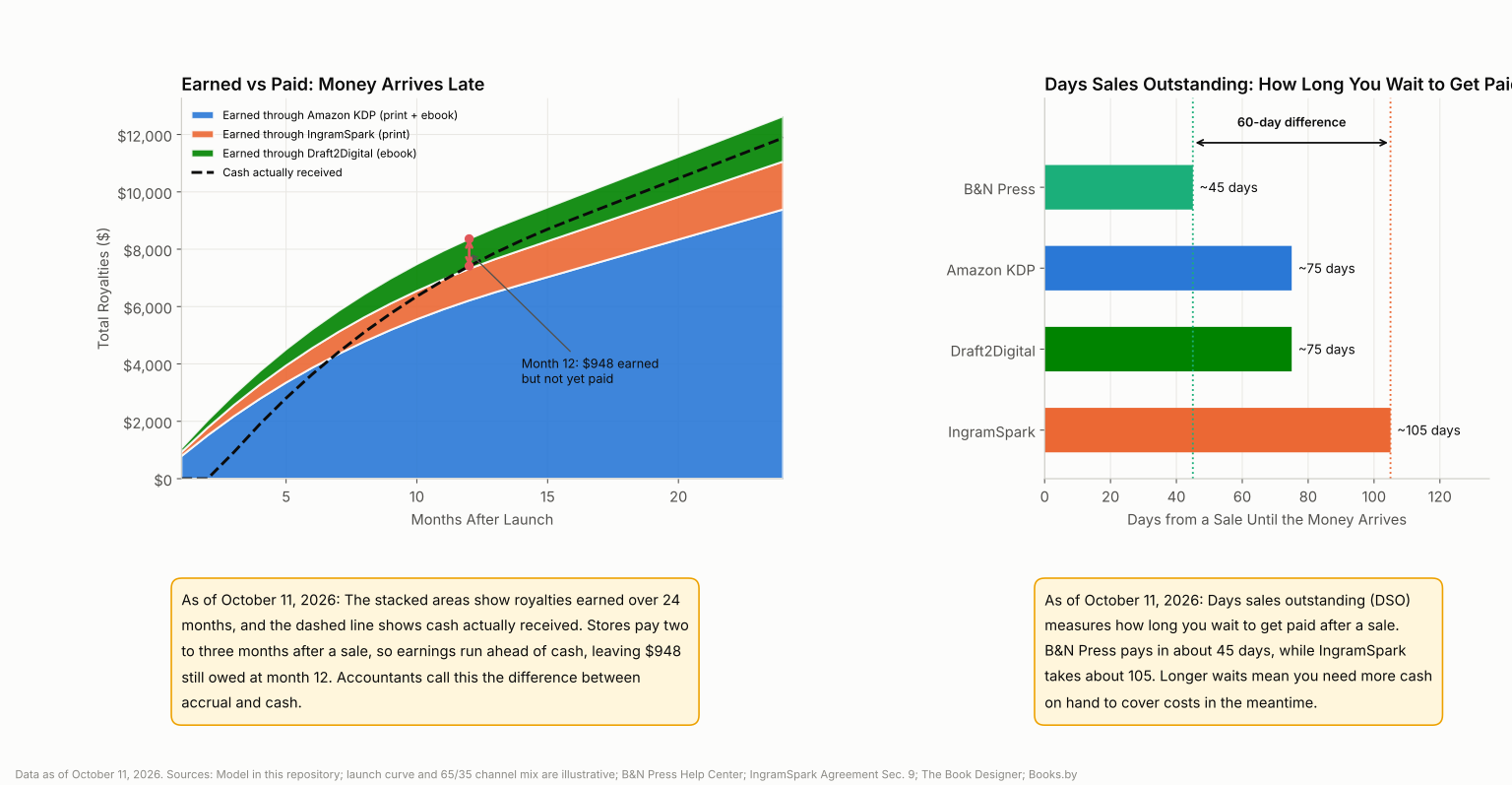
The average number of days between a sale and the cash arriving. Longer waits need more cash on hand.Days to cash = payment terms in days after month end + about 15 days (the average sale happens mid-month)B&N Press pays about 30 days after month end: 30 + 15 = 45 days. IngramSpark pays about 90 days after month end: 90 + 15 = 105 days.
KPI 11. Working capital gap
money earned but not yet received
The cash you are owed at a point in time because stores pay late.Gap = cumulative royalties earned - cumulative cash receivedMonth 12 of the illustrative launch: $8,361 earned - $7,413 received = $948.
KPI 12. KENP rate
Kindle Edition Normalized Pages payout rate
What Kindle Unlimited pays per page read, set monthly from a shared pot. Shown per 1,000 pages.Pay per 1,000 pages = monthly per-page rate x 1,000; average = mean of 12 months; range = highest - lowestAverage $4.55; range $5.01 - $4.19 = $0.82 (20% from low to high).
KPI 13. Breakeven lift
extra sales a cheaper option needs just to tie
The bar an A/B test (a test of version A against version B) must clear before switching to a lower price.Breakeven lift = net per copy of A / net per copy of B - 1Print price test: KDP net at $16.99 = $6.79; at $14.99 = $14.99 x 60% - $3.40 = $5.59; $6.79 / $5.59 - 1 = 21.4%.
KPI 14. Sample size per group
shoppers each version needs for a trustworthy A/B result
Too few shoppers and a difference may be luck.Two-proportion z-test at 95% confidence (z = 1.96) and 80% power (z = 0.84) for the breakeven liftPrint price test at a 2% baseline conversion rate and a 21.4% lift: 18,467 shoppers per group. Ebook test at 3%: 7,814.
How the numbers work

Where Each Number in the Story Comes From

Story pointNumbers shownHow they are calculatedSources
2. Market context3.53M self-published ISBNs (International Standard Book Numbers) in 2025, +38.7%; total 4.17M, +32.5%Growth = 2025 count / 2024 count - 1 = 3,529,980 / 2,545,885 - 1 = 38.7%. Print share of revenue = (hardback $8.2B + paperback $8.0B) / $33.4B = 49%.Bowker via Publishers Weekly, Mar 2026; Circana BookScan via Publishers Weekly; AAP StatShot Annual Report 2025
5. Gross-to-netKDP keeps $6.79; IngramSpark $3.33 on a $16.99 paperbackKDP printing = $1.00 + 200 pages x $0.012 = $3.40. IngramSpark fee = 1.875% market access fee x $16.99 = $0.32. Print costs for IngramSpark ($4.00), B&N Press ($3.50) and Lulu ($5.00) are planning estimates.Profitable.app KDP royalty calculator; IngramSpark Help Center: 2026 pricing changes; B&N Press Help Center: Getting paid; Chapter: Lulu pricing (Sep 2026); PublishDrive Help: pricing plans
6. Cost varianceIngramSpark keeps $3.47 less per copy than KDP; $2.55 of it is the store's cutStore-cut driver = KDP $6.80 - IngramSpark $9.34 = -$2.55; printing = $3.40 - $4.00 = -$0.60; fee = $0.00 - $0.32 = -$0.32. The three add up to -$3.47.Model in this repository (analysis/model.py); Profitable.app KDP royalty calculator; IngramSpark Help Center: 2026 pricing changes
7. EbooksDirect uploads keep $3.49; KDP $3.28; Draft2Digital $3.14; IngramSpark $2.97Direct: $4.99 x 70% = $3.49. KDP: ($4.99 - $0.30 delivery fee) x 70% = $3.28. Draft2Digital: $3.49 x 90% = $3.14. IngramSpark: $3.49 x 85% = $2.97.ScribeCount platform comparison; Profitable.app KDP royalty calculator; PublishDrive vs Draft2Digital (Apr 2026); IngramSpark Agreement (Lightning Source)
8. BreakevenKDP 158 pairs; IngramSpark 272; slowest 511Year-1 fixed costs = platform setup (ISBN, or International Standard Book Number, $125 where you buy your own) + $85 copyright registration + $1,500 illustrative launch budget + subscription. KDP: $1,585 / $10.08 per pair, rounded up = 158.Model in this repository (analysis/model.py); Hypebot on the 2026 USCO fee schedule; ScribeCount: How to publish on IngramSpark; PublishDrive Help: pricing plans
9. ScenariosKDP Year-1 net $1,124 / $5,961 / $30,146 at 10 / 50 / 250 sales a month; switch point 16.612 x (monthly sales x contribution per pair - monthly fee) - platform setup - $85 copyright. Switch point = $13.99 PublishDrive fee / ($7.14 - $6.30) = 16.6.Model in this repository (analysis/model.py); PublishDrive Help: pricing plans
10. Profit calculatorProfit, breakeven books, books still needed, share of costs earned backProfit = books sold x money kept per print + ebook pair, minus launch costs (your launch budget plus the route's setup fees, copyright registration and year-1 subscription); breakeven = launch costs / money kept per pair. Uses the same per-sale numbers as points 5 to 9.Model in this repository (analysis/model.py)
11. Cash timing$948 owed at month 12; 45 to 105 days to cashIllustrative launch: 120 sales of each format in month 1, falling 8% a month to 40; 65% on Amazon, 35% elsewhere. KDP and Draft2Digital pay 2 months later, IngramSpark 3. Days to cash = payment terms + about 15 days.Model in this repository (analysis/model.py); Written Word Media 2025 Indie Author Survey; B&N Press Help Center: Getting paid; IngramSpark Agreement (Lightning Source)
12. Kindle Unlimited$4.19 to $5.01 per 1,000 pages; average $4.55Author-reported monthly KENP (Kindle Edition Normalized Pages) rates from May 2025 to April 2026, multiplied by 1,000. Average = sum of 12 months / 12.Profitable.app KENP rate tracker
13. A/B testPrice cuts need 21% to 27% more sales; store terms 77%Ebook: KDP net at $4.99 = $3.28, at $3.99 = $2.58, lift = 27.1%. Store terms: IngramSpark net at a 40% non-returnable discount ($5.88) / at 55% returnable ($3.33) - 1 = 76.6%.Profitable.app KDP royalty calculator; IngramSpark Help Center: 2026 pricing changes; Model in this repository (analysis/model.py)
Story point numbers match the Tableau story. Every formula is also listed in the How the numbers work section on GitHub.
Reference

Glossary of Analytics and FP&A Terms

A/B test
A fair comparison of two versions on one measure, run long enough to trust the result.
Breakeven lift
How many more sales a cheaper option needs just to match the original.
Breakeven point
Sales at which total money kept equals start-up costs.
Channel share / take rate
The part of the price the store or marketplace keeps.
Coefficient of variation (CV)
How much something swings, compared to its average.
Contribution margin
Money kept from one sale after that sale's own costs.
Cost variance analysis
Explaining a cost gap by splitting it into its causes.
Days sales outstanding (DSO)
Average days between a sale and the cash arriving.
Gross-to-net (GTN)
The steps from list price to the money you keep.
Margin of safety
How far sales can drop before you stop covering costs.
Pool-based payout
Pay that comes from a shared pot split by usage.
Returns reserve
Money held back to cover books that may be returned.
Scenario analysis
Comparing results under slow, normal and great outcomes.
Sensitivity analysis
Changing one input at a time to see which matters most.
Working capital gap
Money earned but not yet collected.
Attribution

Sources